
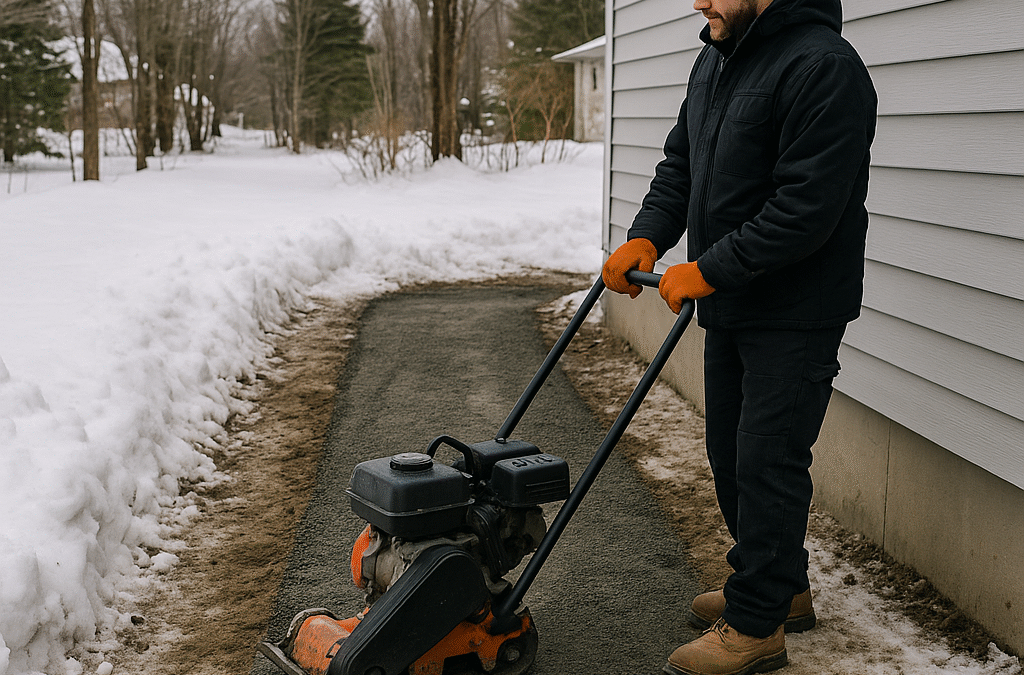
Every winter in Ottawa, Orléans, Rockland, Clarence-Rockland, Russell, and all surrounding areas, we see homeowners dealing with the same frustrating issues: cracked driveways, shifting walkways, uneven surfaces, and frost heaving that pushes materials upward like a slow, powerful wave beneath the ground.
Most people chalk this damage up to “winter being winter,” but the truth is that driveway and walkway failure is almost always preventable, if the right preparation is done before deep freeze arrives.
As a professional excavation and grading team, we spend every December helping homeowners prepare their properties for harsh winter conditions. Once the ground freezes solid, freeze-thaw cycles begin, and anything beneath your driveway or walkway that isn’t compacted properly will expand and contract repeatedly — leading to cracks, sinking areas, bulging, and long-term structural damage.
In this blog, I’ll explain exactly how we prepare driveways and walkways to survive Ottawa winters, how frost heave works, what signs we look for, and why early-winter preparation helps homeowners avoid major spring repair bills.
Why Driveways & Walkways Experience So Much Damage in Winter
1. Freeze-Thaw Cycles Cause Ground Movement
In Ottawa’s climate, we don’t freeze once and stay frozen. Instead, temperatures rise and fall constantly throughout the season.
This process:
- Melts snow
- Saturates the soil
- Refreezes overnight
- Expands the ground upward
- Thaws again
- Drops the structure back down
That cycle repeats dozens of times each winter.
If your driveway or walkway wasn’t prepared correctly, these shifts can cause:
- Cracks
- Uneven surface levels
- Raised edges
- Sinking
- Potholes
- Surface separation
- Interlock shifting
2. Water Always Finds Weak Spots
Improper grading, poor drainage, and low spots in the base cause meltwater to collect under your driveway or walkway. When that water freezes, it expands and forces the material upward, creating frost heave.
3. Heavy Snow Loads Add Pressure
Snowplows, compacted snow piles, vehicles, and freezing rain add additional downward pressure. Combined with upward frost force, the driveway becomes trapped between two competing loads.
Why We Focus on Driveway & Walkway Prep in Early Winter
December is the “sweet spot” for winter prep. The ground is cold but still workable, the soil holds shape well, and damage from fall rains has already made weak spots visible.
When we prepare a driveway or walkway before deep freeze, we:
- Identify unstable areas
- Repair low spots
- Recompact the base
- Improve drainage
- Redirect meltwater
- Strengthen surface support
- Prevent frost heave before it starts
This prep is one of the smartest investments you can make to protect your property all winter long.
How We Prepare Driveways for Winter in Ottawa
We follow a detailed winter preparation process based on local conditions across Orléans, Rockland, Clarence-Rockland, Russell, and other areas surrounding Ottawa.
1. Inspecting the Driveway Condition
We look for:
- Cracks
- Sinking areas
- Raised edges
- Water pooling
- Poor drainage
- Soil softness
- Frost heave signs from previous years
Every driveway tells us exactly where it’s vulnerable.
2. Checking the Base and Sub-Base
Damage almost always starts beneath the surface. If the base wasn’t deep enough, compacted enough, or properly sloped, winter will exploit it.
If needed, we:
- Remove unstable material
- Rebuild the base with proper aggregates
- Recompact in layers
A solid base is the foundation of a winter-proof driveway.
3. Correcting Drainage Issues
Water is the biggest threat to driveway stability.
We improve drainage by:
- Regrading the driveway
- Creating controlled runoff channels
- Installing shallow trenches
- Adding drainage stone
- Ensuring water flows away from the home
This dramatically reduces frost heave risks.
4. Edge Support Reinforcement
Driveway edges often fail first.
We reinforce edges by:
- Adding compacted gravel transitions
- Embedding support material
- Ensuring clean, stable boundary zones
This distributes stress during freeze-thaw cycles.
5. Surface Preparation
If needed, we:
- Level uneven areas
- Repair sinking spots
- Fill early-season cracks
- Replace compromised surface materials
All preparation is designed to minimize winter damage and extend driveway lifespan.
How We Prepare Walkways for Winter
Walkways require special attention because they are narrow, heavily used, and often sit close to foundations or landscaping.
1. Evaluating the Surface for Hazards
Walkways can heave upward, creating dangerous tripping zones. We look for:
- Lifted pavers
- Cracked slabs
- Loose stones
- Tilted surfaces
- Water pooling
2. Checking the Bedding Layer
Interlock walkways rely on a stable bedding layer. Winter moisture often washes it out.
We remove and replace weak material with:
- High-quality crushed stone
- Proper compaction
- Winter-ready granular base
3. Resetting and Leveling Pavers (If Present)
We lift, reset, and re-level stones to ensure perfect alignment before freeze hits.
4. Improving Side Drainage
Walkways often sit beside lawns or gardens that produce a lot of meltwater.
We create:
- Slopes away from the house
- Side drainage paths
- Meltwater channels
- Clear exit points
Proper drainage stops winter heave.
What Frost Heave Looks Like (And Why It Happens)
Frost heave occurs when moisture in the soil freezes and expands. It pushes driveway and walkway materials upward, causing:
- Bulging
- Cracks
- Separation
- Misalignment
- Uneven surfaces
Once frost heave begins, it worsens each cycle unless the underlying cause is fixed.
In Ottawa, Orléans, Rockland, and the surrounding areas, frost heave is extremely common due to high clay content in many soils. This makes driveway prep even more important.
Signs Your Driveway or Walkway Needs Winter Prep
If you notice any of the following, you should address the issue before deep freeze arrives:
- Water pooling after rain or early snowmelt
- Visible cracks forming
- Edges breaking away
- Sinking or soft areas
- Ice patches forming regularly
- Interlock stones shifting
- Uneven or tilted walkway surfaces
- Drainage issues nearby
If you’ve had recurring problems year after year, early-winter prep can finally break the cycle.
Preparing for Spring Starts in Winter
Most homeowners want to upgrade or repair driveways and walkways in the spring. But spring schedules fill up fast, and the ground remains saturated for weeks after thaw.
Completing prep in winter allows:
- Immediate spring construction
- Faster project timelines
- Fewer delays
- Clearer access for equipment
- Better soil stability for summer work
Winter preparation sets you up for the smoothest possible spring improvements.
Why Homeowners Across Ottawa Trust Us for Winter Driveway & Walkway Prep
We’ve worked through countless winters across Ottawa, Orléans, Rockland, Clarence-Rockland, Russell, and nearby communities. We understand:
- Local soil types
- Freeze-thaw cycles
- Drainage patterns
- Driveway base issues
- Frost heave behavior
Our winter preparation process is designed for long-lasting results, not seasonal quick fixes.
Call 613-834-0050 to Schedule Your Winter Driveway & Walkway Prep Service
If you want to protect your driveway or walkway from winter damage, heaving, and cracking, early-winter preparation is the smartest and most cost-effective step.
Call 613-834-0050 to schedule your winter driveway and walkway prep service.
We proudly serve Ottawa, Orléans, Rockland, Clarence-Rockland, Russell, and all surrounding areas.