
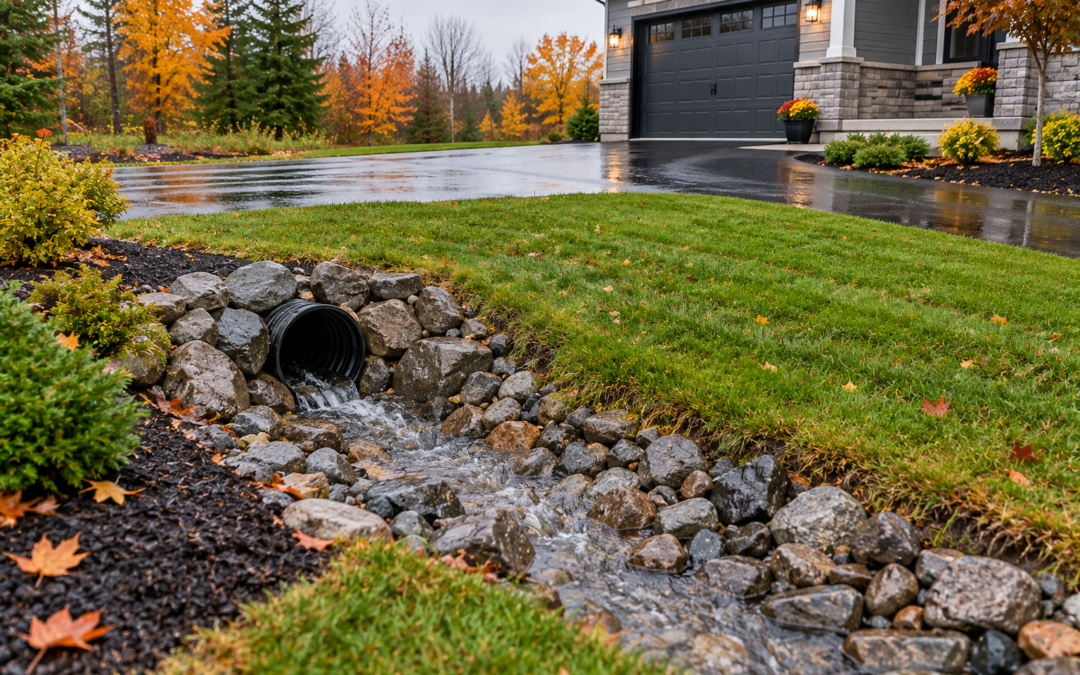
As temperatures begin to fall across Eastern Ontario, property owners often focus on preparing homes, driveways, landscaping, and outdoor areas for colder weather. Yet one important part of the property can easily be overlooked: the way water is moving across the land.
The weeks before winter can reveal valuable information about grading and drainage. Autumn rainfall may expose low spots that remain saturated, sections of driveway that repeatedly wash out, water collecting near foundations, or runoff cutting channels through lawns and landscaped areas.
These conditions are worth paying attention to because winter does not necessarily make drainage problems disappear. Water remaining in vulnerable areas can freeze, thaw, and return during warmer periods. When spring arrives, melting snow can place even more pressure on areas that already struggle to manage runoff.
Across Ottawa, Orléans, Rockland, Clarence-Rockland, Russell, and surrounding Eastern Ontario communities, seasonal weather makes effective grading and drainage an important part of property maintenance and site preparation.
At Gallant Services, we provide professional excavation, grading, drainage, land clearing, driveway preparation, culvert work, and complete site preparation. By evaluating how water behaves before the ground freezes, property owners can gain a clearer understanding of improvements that may help their land perform better through winter and into spring.
Autumn Rainfall Can Expose Problems That Summer Hides
During dry summer periods, a property may appear to drain perfectly well.
Lawns remain firm. Driveways are dry. Low areas may not be particularly noticeable.
Repeated autumn rainfall can tell a different story.
As soil becomes wetter, areas with inadequate drainage may remain saturated longer. Water may begin collecting in depressions or travelling along routes that were not obvious during summer.
Property owners may notice:
- Standing water in the lawn
- Muddy sections that remain wet for days
- Runoff flowing toward buildings
- Gravel washing from driveways
- Erosion along slopes
- Water collecting near culverts
These patterns provide useful clues about the property’s existing grade.
Water Always Looks for the Lowest Route
The basic principle behind property drainage is simple: water follows elevation.
If the land slopes away from a building toward an appropriate drainage area, runoff has a natural path.
Problems develop when that path is interrupted or when the lowest area happens to be somewhere water should not remain.
A small depression beside a garage, for example, may collect runoff from a surprisingly large portion of the property.
Likewise, a driveway rut can become a channel that directs water toward the wrong location.
Professional grading helps create intentional drainage routes rather than allowing water to determine its own path.
Watch What Happens Around the Foundation
One of the most important areas to observe during heavy rainfall is the ground immediately surrounding the home.
Surface water should not repeatedly collect beside foundation walls.
If it does, the surrounding grade may have settled or may no longer be directing runoff effectively.
Property owners should look for conditions such as:
- Puddles beside the foundation
- Soil that remains saturated
- Visible settlement
- Erosion near downspouts
- Water flowing toward the house
Exterior grading is only one element of overall water management, but maintaining appropriate surface drainage around a structure is important.
Gallant Services can evaluate the surrounding land and determine whether professional regrading or excavation may help improve water movement.
Driveways Often Reveal Drainage Problems First
Driveways are particularly good at revealing where runoff is concentrated.
A gravel driveway may develop channels after storms. Material may disappear from the same area repeatedly, or potholes may return shortly after repairs.
These conditions can indicate that water is travelling along or across the driveway rather than being directed away effectively.
On rural properties throughout Rockland, Clarence-Rockland, Russell, and surrounding Eastern Ontario communities, long driveways can intersect several natural drainage routes.
Ditches, grading, driveway crowns, and culverts may all contribute to how successfully runoff is managed.
Replacing lost gravel without addressing the source of the water may only provide temporary improvement.
Culverts Should Be Observed Before Winter
Culverts perform an important job on many rural and semi-rural properties.
They allow water to pass beneath driveways and access routes rather than flowing across them.
Before winter, property owners can observe whether water is entering and leaving culverts effectively.
Potential warning signs include:
- Water backing up on one side
- Erosion around the inlet or outlet
- Sediment buildup
- Persistent standing water
- Runoff crossing the driveway instead
A drainage system is only effective when water can continue moving through it.
Culvert conditions should therefore be considered alongside surrounding ditch and driveway elevations.
Low Areas May Become More Obvious in Fall
A shallow low spot can be difficult to notice during dry weather.
After repeated rain, it may become impossible to miss.
These areas can develop because of:
- Natural terrain
- Soil settlement
- Previous excavation
- Landscaping changes
- Compaction
- Altered drainage routes
Adding soil directly to the depression may seem like an easy solution, but doing so without understanding the surrounding elevations can redirect water somewhere else.
Professional grading considers where the water originates and where it should ultimately travel.
Erosion Shows Where Water Has Too Much Energy
Standing water is not the only sign of poor drainage.
Sometimes water moves too quickly.
Concentrated runoff travelling down a slope can remove soil and create channels.
Property owners may see:
- Exposed roots
- Small gullies
- Washed-out garden areas
- Gravel movement
- Sediment collecting downhill
These conditions show exactly where water is travelling.
Professional site work can help reshape the affected area or establish a more controlled drainage route.
Downspouts Can Influence the Entire Yard
Roof runoff can represent a significant amount of water.
Gutters collect precipitation across the roof and concentrate it at downspouts.
If that water is discharged into a low or poorly graded area, the surrounding ground may quickly become saturated.
During autumn storms, property owners should observe where downspout water travels after it reaches the ground.
Does it continue away from the home?
Does it stop several feet away?
Does it travel toward the driveway or a neighbouring low area?
Understanding this movement can help identify where grading improvements may be useful.
Why Drainage Matters Before Freezing Temperatures
Water remaining in soil and aggregate becomes particularly important as temperatures fall.
Eastern Ontario experiences repeated freezing and thawing throughout the colder seasons.
When moisture is present in susceptible materials, these temperature changes can contribute to movement.
Driveways, walkways, and other exterior surfaces may show the effects of poor drainage more clearly after winter.
Effective water management cannot eliminate freeze-thaw conditions, but reducing unnecessary water accumulation helps create better site conditions.
Preparing for Spring Starts Before Winter
Spring drainage problems often begin long before spring arrives.
Snow accumulates across the property throughout winter.
When temperatures rise, large amounts of water can be released over a relatively short period.
If the ground remains frozen or partially frozen, much of that water may travel across the surface rather than soaking into the soil.
A property that already has poor drainage routes can experience significant pooling during this period.
Identifying obvious drainage weaknesses before winter provides an opportunity to plan improvements before the next spring thaw.
Rural Properties Need a Wider View
Large rural properties can collect runoff from substantial areas.
A wet section beside the house may actually receive water from a distant field, wooded slope, or higher part of the property.
This is particularly relevant throughout Rockland, Clarence-Rockland, Russell, and surrounding communities where larger lots are common.
Drainage evaluation should therefore look beyond the immediate problem area.
Gallant Services considers how water travels across the broader property before recommending grading or excavation work.
Smaller Residential Properties Require Precision
Ottawa and Orléans properties often present different challenges.
Homes may sit closer together, leaving less room for surface drainage.
Driveways, patios, walkways, fences, gardens, and neighbouring properties can all influence water movement.
A relatively small change in elevation can make a noticeable difference.
Professional grading helps manage runoff within these tighter environments while considering existing property features.
Landscaping Can Accidentally Block Drainage
Landscaping evolves over time.
A new garden bed may be raised above the surrounding lawn. Decorative stone may be added beside the house. A walkway or patio may cross an existing drainage route.
Individually, these changes can appear minor.
Together, they can alter how water moves across the property.
Before making major landscaping changes, property owners should consider existing drainage.
If the yard already experiences standing water, correcting the underlying grade first can help protect the investment in future landscaping.
Sheds and Garages Change Water Movement
Every new structure introduces another roof surface.
A detached garage, workshop, or shed collects precipitation and directs it toward surrounding ground.
If the site was not graded with this additional runoff in mind, wet areas may develop around the structure.
The building may also interrupt a drainage route that existed before construction.
Professional site preparation considers both the structure and the surrounding property so water can continue moving appropriately after construction.
New Construction Should Include Drainage Planning
When building a new home, garage, workshop, or addition, drainage should be considered from the earliest stages of site preparation.
Construction changes elevations and surfaces.
Excavation, foundation work, backfilling, driveways, and landscaping all influence runoff.
Addressing water management during construction is generally easier than trying to correct problems after every surface has been completed.
Gallant Services integrates excavation and grading so the finished site can function as a complete property.
Regrading Can Restore an Older Property
Drainage problems do not occur only on new construction sites.
Older properties can gradually develop problems as soil settles and landscaping changes.
A yard that drained effectively twenty years ago may now contain low areas.
Driveways may have settled, gardens may have been added, and outdoor structures may have changed runoff patterns.
Professional regrading can help restore more appropriate elevations without requiring the property to be completely redeveloped.
Drainage Improvements Can Increase Usable Space
A persistently wet section of yard is often avoided.
It may be difficult to mow, unsuitable for recreation, and challenging to landscape.
Correcting the grade can sometimes transform that underused area into functional outdoor space.
Depending on the property, improved drainage can support:
- Lawns
- Gardens
- Play areas
- Patios
- Walking areas
- Future property improvements
This makes drainage work both protective and practical.
Plan Before Covering the Problem
One of the biggest mistakes property owners can make is hiding visible drainage symptoms without addressing the cause.
Adding soil, gravel, sod, or decorative stone may temporarily improve appearance.
But if water continues arriving at the same location, the underlying issue remains.
Professional site evaluation asks three basic questions:
Where is the water coming from?
Why is it stopping here?
Where should it go instead?
Those answers help guide effective grading and excavation.
A Property Tells Its Story During Rain
A dry property can hide drainage weaknesses.
A rainy day often reveals them.
Water tracing a line through gravel, pooling beside a garage, running toward a foundation, or collecting in a backyard depression provides valuable information about how the land is functioning.
Property owners who observe these patterns before winter can enter the next construction or landscaping season with a much clearer understanding of what their property may need.
At Gallant Services, we use that information together with the site’s terrain, access, soil conditions, existing improvements, and future plans to determine an appropriate approach.
Professional Drainage and Grading Across Eastern Ontario
Gallant Services provides professional excavation, grading, drainage, culvert work, land clearing, driveway preparation, and complete site preparation throughout Ottawa, Orléans, Rockland, Clarence-Rockland, Russell, and surrounding Eastern Ontario communities.
We help property owners address:
- Standing water
- Poor grading
- Driveway washouts
- Erosion
- Wet yards
- Drainage around buildings
- Culvert concerns
- Site preparation for future construction
Every property handles water differently, which is why our approach begins with understanding the site rather than applying the same solution everywhere.
Contact Gallant Services for Professional Drainage and Grading
Before winter covers the ground, take a closer look at what autumn rainfall is revealing about your property.
Recurring puddles, erosion, driveway washouts, saturated areas, and water moving toward structures may indicate that grading or drainage improvements deserve attention.
Call Gallant Services at (613) 834-0050 or email gallant.serv@gmail.com to discuss professional excavation, grading, drainage, culvert work, land clearing, driveway preparation, and site preparation services.
Gallant Services proudly serves Ottawa, Orléans, Rockland, Clarence-Rockland, Russell, and surrounding Eastern Ontario communities, helping property owners prepare their land for better drainage, dependable access, and long-term functionality through every season.