
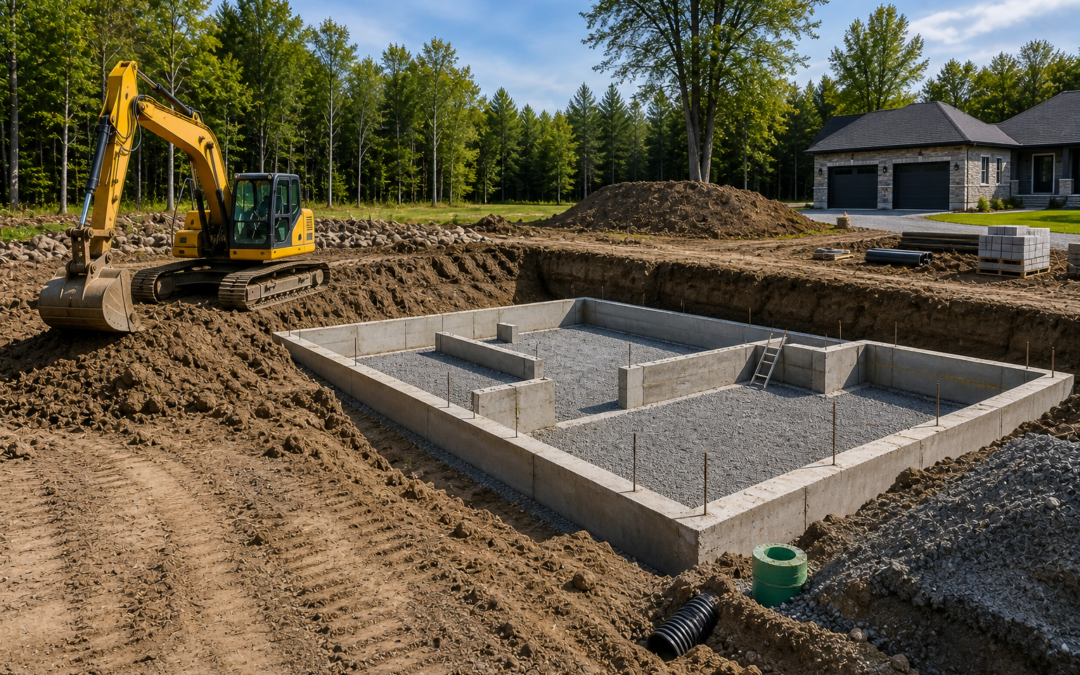
When a new home, garage, workshop, or addition begins taking shape, the foundation is often viewed as the true starting point of construction. Yet long before concrete is poured, a significant amount of work may already have taken place beneath and around the future structure.
Professional site preparation is what transforms an ordinary piece of land into a construction-ready property. Clearing, excavation, grading, drainage planning, access preparation, and soil management all contribute to creating the conditions needed for the next phase of the project.
Across Ottawa, Orléans, Rockland, Clarence-Rockland, Russell, and surrounding Eastern Ontario communities, site conditions can vary dramatically from one property to another. Some projects begin on wooded rural lots. Others take place beside existing homes on compact residential properties. Soil, slopes, groundwater, drainage patterns, and access can all influence how the site needs to be prepared.
At Gallant Services, we provide excavation, grading, drainage, land clearing, driveway preparation, and related site services. We approach foundation preparation as part of the complete property rather than simply digging a hole for a building.
Understanding what happens before foundation construction can help property owners appreciate why professional site preparation is so important to the long-term success of a project.
It Starts With Understanding the Property
Before excavation equipment begins moving soil, the property itself needs to be understood.
Every site has existing conditions that can influence construction, including:
- Natural elevations
- Soil composition
- Surface drainage
- Vegetation
- Existing structures
- Access limitations
- Underground services
- Future property plans
A rural property near Russell may require extensive clearing and a long construction access route. A residential project in Orléans may involve excavation within a much smaller area surrounded by existing landscaping and neighbouring homes.
These projects cannot be approached in exactly the same way.
Evaluating the property helps establish an excavation plan suited to the actual site.
Clearing Creates the Working Area
If the proposed construction area is wooded or overgrown, clearing is often one of the first physical stages.
This may involve removing brush, trees, stumps, roots, surface debris, and organic material where required.
Clearing needs to extend beyond the exact building footprint in many cases. Construction crews and equipment need room to work, while excavated soil and building materials may also require temporary space.
Driveway access, utility routes, drainage work, and future landscaping should also be considered.
At Gallant Services, we believe clearing should support the complete construction process rather than simply make the building footprint visible.
Why Stumps and Organic Material Need Attention
A site may appear clear after trees and vegetation have been removed, but what remains underground is equally important.
Stumps, roots, topsoil, and other organic material are generally not suitable as structural support beneath permanent improvements.
Organic material can break down over time. Where stable support is required, unsuitable materials may need to be removed so appropriate base materials can be installed.
This is one reason professional site preparation goes deeper than surface clearing.
What cannot be seen after construction can be just as important as the finished work above ground.
Construction Access Needs to Be Established
Before foundation work begins, equipment must be able to reach the site safely.
Excavators, loaders, concrete vehicles, delivery trucks, and other machinery may all require access.
On undeveloped rural properties around Rockland, Clarence-Rockland, and Russell, this can involve preparing a substantial driveway or temporary construction route.
Access preparation may include:
- Clearing vegetation
- Excavating unsuitable material
- Establishing grades
- Installing aggregate
- Addressing drainage crossings
- Preparing culverts where appropriate
Reliable access can help keep later construction stages moving efficiently.
The Building Area Must Be Positioned Correctly
Once the site is accessible, the building area needs to be prepared according to the construction plan.
Foundation excavation is precision work.
The excavation needs to accommodate the intended foundation while allowing appropriate working space for construction activities.
Depth, dimensions, and elevations matter.
Over-excavation can create additional work, while insufficient excavation can interfere with foundation construction.
Professional equipment and experienced operation help maintain accuracy throughout this stage.
Soil Conditions Can Change the Excavation Approach
The soil beneath a property is not always uniform.
One site may contain dense clay, while another includes sand, gravel, rock, fill, or a combination of materials.
Conditions can even change within the same excavation area.
Soil influences:
- Excavation methods
- Drainage
- Ground stability
- Material handling
- Base preparation
Eastern Ontario properties can present a wide variety of ground conditions, which is why the excavation approach needs to remain responsive to what is found on site.
Unsuitable Material May Need to Be Removed
Not every material encountered during excavation should remain beneath a structure or other permanent improvement.
Soft, disturbed, organic, or otherwise unsuitable material may require removal depending on the project specifications and site conditions.
Suitable material may then be placed and prepared as required for subsequent construction.
This process helps create more consistent conditions beneath the future structure.
Attempting to avoid necessary excavation at this stage can create challenges that become much more difficult to address once construction is complete.
Water Management Begins Before the Foundation Exists
Drainage should never be treated as an afterthought.
Even before a building is constructed, it is important to understand how water reaches and leaves the site.
A new structure will change existing drainage patterns. Its roof will collect precipitation, while the completed foundation, driveway, walkways, and landscaping will alter the surfaces over which water travels.
Site preparation should anticipate these changes.
Gallant Services considers surrounding elevations and drainage routes so future grading can direct surface water appropriately around the completed property.
Excavation Can Reveal Unexpected Water Conditions
Sometimes water issues become more apparent once excavation begins.
Ground conditions may reveal:
- Saturated soil
- Natural seepage
- Low-lying areas
- Existing drainage paths
- Unexpected water accumulation
These conditions need to be evaluated rather than simply covered up.
The appropriate response depends on the site and construction requirements, but recognizing water conditions early provides an opportunity to address them before the project advances.
Rough Grading Helps Shape the Construction Site
Foundation excavation is only one part of preparing the property.
The surrounding site also needs appropriate elevations.
Rough grading begins shaping the land around the construction area and can establish:
- Equipment working areas
- Driveway approaches
- Drainage routes
- Future lawn elevations
- Access around the building
This stage helps connect the foundation area with the rest of the property.
A building should not sit independently from its surroundings. The complete site needs to work together.
Utility Planning Can Reduce Future Excavation
New buildings usually require services.
Depending on the property and project, these may include water, electrical, communications, drainage infrastructure, or other underground connections.
Planning utility routes before final grading can help avoid reopening completed areas later.
For rural properties, utility runs may extend considerable distances.
Coordinating utility trenching with other excavation work can make the overall site preparation process more efficient.
Septic Considerations Can Influence Rural Site Planning
Many rural properties in Rockland, Clarence-Rockland, Russell, and surrounding areas rely on private septic systems.
When preparing a new construction site, the location of septic infrastructure can influence the overall property layout.
Building placement, driveways, drainage routes, and future structures should all be considered as part of the broader plan.
The goal is to avoid creating conflicts between one property improvement and another.
Thoughtful planning before foundation construction can help preserve space for all required systems.
Driveway Elevations Need to Work With the Building
A driveway is not simply a route from the road to the house.
Its elevation needs to work with the garage, building entrance, drainage, and surrounding land.
If driveway grades are poorly coordinated, water may be directed toward the garage or foundation.
On larger properties, the driveway may also cross natural drainage areas that require culverts or other water-management measures.
Planning these elevations during site preparation helps integrate access with the finished property.
Compact Residential Sites Require Careful Excavation
Site preparation is not limited to large rural projects.
In Ottawa and Orléans, additions, infill projects, detached garages, and other residential improvements may require excavation within confined spaces.
Existing features can include:
- Homes
- Fences
- Trees
- Patios
- Walkways
- Neighbouring properties
- Established landscaping
Equipment selection and movement become especially important in these environments.
Careful excavation helps complete necessary work while limiting unnecessary disturbance.
Foundation Backfilling Is Another Important Stage
Once foundation construction reaches the appropriate stage, the excavated area around the foundation eventually needs to be backfilled.
Backfilling should be coordinated with drainage requirements and the intended final grade.
The goal is not simply to push soil back into the excavation.
Material placement and site shaping influence how the surrounding property will perform later.
This stage also creates the transition from foundation work toward final grading and landscaping.
Final Grades Need to Direct Water Appropriately
After major construction activities are complete, the property can move toward final grading.
This stage establishes the finished contours around the home or building.
Proper grading should support effective surface drainage while preparing the property for lawns, gardens, walkways, and other improvements.
Low areas and inappropriate slopes can lead to recurring water problems.
This is why drainage planning that began before foundation excavation remains important through the final stages of the project.
Site Preparation for Detached Garages and Workshops
The same principles apply to accessory buildings.
A detached garage or workshop requires more than a level-looking patch of ground.
Site preparation may include:
- Clearing
- Excavation
- Base preparation
- Foundation excavation
- Drainage grading
- Driveway extension
- Utility trenching
Property owners should also consider how the new building affects existing drainage and access.
Gallant Services can coordinate the site work required to prepare these projects from the ground up.
Preparing for Future Property Improvements
Construction planning should consider what the property may need several years from now.
A new home may eventually be joined by:
- A detached garage
- A workshop
- Additional parking
- Outdoor living areas
- Other accessory improvements
It is not necessary to build everything at once, but early planning can influence where drainage routes, utilities, and access areas are located.
Avoiding conflicts today can make future property development easier.
Why Professional Excavation Equipment Matters
Foundation and site preparation require both power and precision.
Professional equipment allows soil and aggregate to be moved efficiently while maintaining the grades and dimensions required for the project.
Different machines may be appropriate for different sites.
Larger rural properties can provide generous working space, while compact residential projects may require equipment suited to tighter access.
Using appropriate machinery helps our team adapt to the conditions of each property.
A Strong Foundation Begins With Strong Site Preparation
By the time concrete is poured, many important decisions have already been made.
The property has been evaluated. Vegetation may have been cleared. Access has been established. Soil has been excavated. Drainage has been considered. Grades have begun taking shape.
These steps may eventually disappear beneath the finished home and landscaping, but their influence remains.
A properly prepared site helps the foundation become part of a property that functions effectively as a whole.
Professional Foundation Site Preparation Across Eastern Ontario
From wooded rural lots to established residential properties, every construction site requires an approach suited to its conditions.
Gallant Services provides professional excavation, grading, drainage, land clearing, driveway preparation, utility trenching, and site preparation services throughout Ottawa, Orléans, Rockland, Clarence-Rockland, Russell, and surrounding Eastern Ontario communities.
We help prepare sites for:
- New homes
- Detached garages
- Workshops
- Additions
- Driveways
- Other residential and rural improvements
Our goal is to establish stable, practical site conditions that support both the immediate construction project and the long-term use of the property.
Contact Gallant Services Before Your Foundation Project Begins
The work beneath and around a foundation matters long after construction equipment leaves the property.
If you are planning a new home, garage, workshop, addition, or other project, professional excavation and site preparation can help establish a stronger starting point.
Call Gallant Services at (613) 834-0050 or email gallant.serv@gmail.com to discuss professional excavation, grading, drainage, land clearing, driveway preparation, and site preparation services.
Gallant Services proudly serves Ottawa, Orléans, Rockland, Clarence-Rockland, Russell, and surrounding Eastern Ontario communities, helping property owners prepare construction sites carefully from the ground up.