
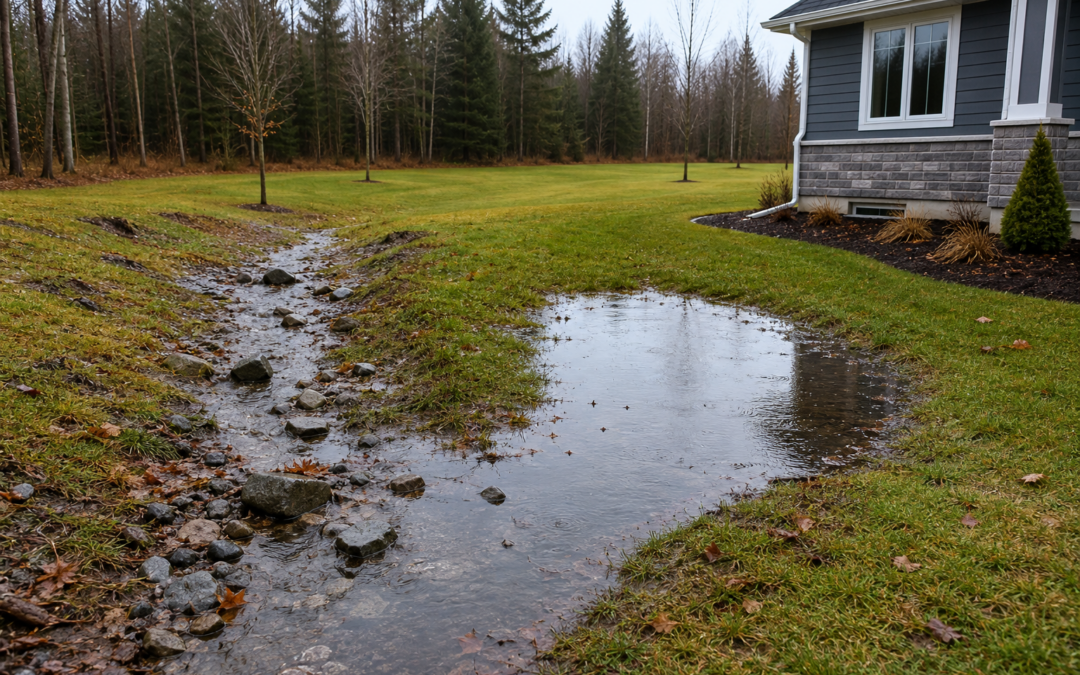
A puddle that remains in the yard after heavy rain may seem like a minor inconvenience. A wet section beside the driveway might appear to be nothing more than a seasonal problem. However, when water repeatedly collects in the wrong places, the visible moisture can be only one part of a much larger issue developing beneath the surface.
Poor drainage can gradually affect soil stability, foundations, driveways, landscaping, slopes, and other property improvements. Because much of this damage develops underground, homeowners may not recognize the seriousness of the problem until repairs become more extensive.
Across Ottawa, Orléans, Rockland, Clarence-Rockland, Russell, and surrounding Eastern Ontario communities, properties experience demanding seasonal conditions. Heavy rainfall, spring snowmelt, frozen ground, and repeated freeze-thaw cycles can expose weaknesses in drainage and grading. When water does not have an effective route away from structures and high-use areas, the property can experience recurring problems year after year.
At Gallant Services, we provide excavation, grading, drainage, land clearing, and site preparation services designed to address the conditions contributing to poor water management. We look beyond the visible puddle to understand how elevations, soil, runoff, and existing drainage features interact across the property.
Poor Drainage Often Begins With the Grade
Water naturally moves downhill. That simple principle makes property grading one of the most important elements of drainage.
Ideally, the land surrounding a building should help direct surface water away from the foundation and toward an appropriate drainage area. When the grade is too flat, slopes toward the structure, or contains depressions, water can collect where it does not belong.
Over time, grading can also change.
Soil may settle, landscaping projects can alter elevations, driveway work can redirect runoff, and erosion can reshape parts of the property.
A drainage problem that was not noticeable several years ago may gradually become more obvious as these conditions change.
Professional grading can help restore appropriate elevations and establish a more effective path for surface water.
What Happens When Soil Remains Saturated?
Healthy soil naturally contains some moisture, but repeatedly saturated ground behaves differently.
When soil remains excessively wet, it can lose some of its ability to provide stable support. Depending on soil composition and site conditions, prolonged saturation may contribute to soft ground, settlement, erosion, or movement.
These problems can affect areas supporting:
- Driveways
- Walkways
- Patios
- Landscaping
- Access routes
- Other property improvements
The issue becomes especially important when excess water repeatedly accumulates near structures.
Proper drainage helps manage water before persistent saturation becomes an ongoing concern.
Water Around a Foundation Deserves Attention
Water collecting near a home’s foundation should not simply be treated as an unavoidable part of rainfall.
Poor grading can direct runoff toward the building instead of away from it. When the surrounding soil becomes saturated, moisture conditions around the foundation can become more challenging.
Warning signs may include:
- Persistent wet areas near the home
- Water collecting beside foundation walls
- Erosion around the building
- Damp basement conditions
- Visible changes in surrounding soil
Not every moisture issue has the same cause, which is why evaluating the entire site is important.
Gallant Services can assess exterior grading and drainage conditions to determine whether excavation or property regrading may help improve water movement.
The Hidden Connection Between Drainage and Driveway Damage
A driveway may appear to be completely separate from a drainage problem, but water frequently contributes to driveway deterioration.
When runoff crosses a gravel driveway without proper management, it can gradually carry material away. Small channels can become larger washouts, and repeated water movement can weaken sections of the driveway base.
Standing water can also contribute to soft areas and surface deterioration.
On rural properties around Rockland, Clarence-Rockland, Russell, and surrounding Eastern Ontario communities, long driveways may cross several natural drainage paths. These areas sometimes require grading, ditch improvements, or culvert solutions to move water effectively.
Correcting the water problem rather than repeatedly replacing washed-out material can provide a more practical long-term solution.
Spring Snowmelt Can Reveal Drainage Weaknesses
Eastern Ontario winters create unique drainage conditions.
During spring, large amounts of snow can melt over a relatively short period. If the ground remains partially frozen, water may not infiltrate the soil normally.
Instead, runoff travels across the surface.
Properties with inadequate grades or drainage routes can experience significant pooling during this period. Low areas fill quickly, driveways can become saturated, and runoff may move toward buildings.
Spring therefore provides property owners with an excellent opportunity to observe how water actually travels across their land.
Areas that repeatedly collect water during snowmelt may benefit from professional evaluation.
Freeze-Thaw Cycles Can Magnify Existing Problems
Water and freezing temperatures can be a difficult combination for poorly drained properties.
When water enters soil or aggregate and freezes, it expands. Repeated freezing and thawing can contribute to movement in susceptible areas.
This can affect:
- Driveways
- Walkways
- Gravel surfaces
- Landscape areas
- Other exterior improvements
Effective drainage helps reduce unnecessary water accumulation before freezing temperatures arrive.
Although drainage cannot eliminate Eastern Ontario’s winter conditions, proper grading can help a property manage moisture more effectively throughout seasonal changes.
Erosion Is Often a Drainage Problem in Disguise
Erosion occurs when water moves soil from one location to another.
A small channel forming in the yard may initially seem insignificant. But if water follows the same route during every storm, the channel can gradually deepen.
Erosion may appear:
- Along slopes
- Beside driveways
- Near downspout discharge areas
- Around culverts
- Along drainage ditches
- Near exposed soil
Rather than simply replacing lost soil, it is important to understand why water is concentrating in that location.
Professional grading and drainage improvements can help control the direction and speed of runoff.
Why Low Spots Keep Returning
Some homeowners repeatedly fill low areas in their yards, only to see standing water return.
Adding soil may temporarily eliminate the visible depression, but if the surrounding elevations continue directing water toward that location, the underlying drainage problem remains.
The solution may require looking at the broader grade.
Where does the water originate? Where should it go? What is preventing it from getting there?
Gallant Services approaches grading from this larger perspective. The goal is not simply to eliminate one puddle but to establish a practical drainage pattern across the relevant portion of the property.
Swales Can Help Guide Surface Water
A swale is a shallow graded channel designed to guide runoff.
Unlike a deep ditch, a properly designed swale can often blend into the surrounding landscape while still performing an important drainage function.
Swales may help move water:
- Away from structures
- Across larger yards
- Toward suitable drainage areas
- Around landscaped spaces
Their effectiveness depends on appropriate elevation and slope.
Professional grading helps ensure water continues moving rather than collecting midway through the drainage route.
Culverts Play an Important Role on Many Properties
Culverts allow water to pass beneath driveways and access routes.
They are especially common on rural and semi-rural properties throughout Rockland, Clarence-Rockland, Russell, and surrounding areas.
When a culvert becomes damaged, obstructed, poorly positioned, or overwhelmed, water may begin collecting on one side of the driveway or flowing across the surface.
This can contribute to erosion and driveway deterioration.
Culvert work should therefore be coordinated with the surrounding drainage system. Replacing or installing a culvert without considering elevations and water flow may not resolve the broader issue.
Drainage Around New Construction Should Be Planned Early
The best time to think about drainage is before a construction project is completed.
New homes, garages, workshops, driveways, additions, and outdoor improvements can all change the way water travels across a property.
A new building introduces roof runoff. A driveway changes the surface water previously travelled across. Excavation changes elevations, while landscaping can create new high and low areas.
By considering drainage during site preparation, grading can be designed around the completed project rather than corrected afterward.
Gallant Services incorporates water management considerations into excavation and grading work so the finished property can function as a complete site.
Rural Properties Require Large-Scale Water Management
Large properties can collect and move substantial volumes of water.
On rural lots near Russell, Rockland, and Clarence-Rockland, runoff may travel from fields, wooded areas, neighbouring elevations, or long slopes before reaching the developed portion of the property.
Managing this water may require a combination of:
- Grading
- Ditches
- Swales
- Culverts
- Strategic drainage routes
- Erosion control
Understanding the entire property is particularly important in these situations.
Moving water away from one location without considering where it will travel next can simply transfer the problem elsewhere.
Smaller Residential Lots Have Their Own Drainage Challenges
In Ottawa and Orléans, properties may have less space available for drainage.
Homes can be closer together, landscaping may occupy much of the yard, and driveways or patios create additional hard surfaces.
This makes accurate grading especially important.
Water needs to be managed without creating problems around the home or elsewhere on the property.
Even relatively small elevation adjustments can influence the direction of runoff, which is why precision matters.
Landscaping Should Work With the Property Grade
Landscaping can dramatically improve a property, but it should not interfere with drainage.
Raised gardens, patios, walkways, decorative stone, and other improvements can alter surface elevations.
If landscaping blocks an existing drainage route, water may begin collecting in an unexpected area.
Before major landscaping work, it can be worthwhile to consider how the finished design will interact with the property’s grade.
Proper site preparation helps create a foundation on which landscaping and drainage can work together.
Signs That a Professional Drainage Evaluation May Be Needed
Property owners should pay attention to recurring patterns rather than isolated weather events.
Potential warning signs include:
- Water repeatedly pooling in the same location
- Soil washing away after storms
- Persistent muddy areas
- Gravel disappearing from sections of a driveway
- Water flowing toward the home
- Low spots becoming increasingly noticeable
- Culvert areas overflowing
- Sections of lawn remaining saturated
These conditions do not automatically mean extensive excavation is necessary. However, they indicate that understanding the source and movement of water may be worthwhile.
Fix the Cause, Not Just the Visible Damage
One of the most important principles of effective drainage work is addressing the cause rather than repeatedly repairing the symptom.
Replacing washed-out gravel without redirecting runoff may result in another washout. Filling a low spot without correcting surrounding grades may allow water to return. Repairing erosion without controlling the water that caused it can create an ongoing maintenance cycle.
At Gallant Services, we evaluate how water interacts with the property so excavation, grading, and drainage improvements can target the underlying conditions.
Better Drainage Can Improve Overall Property Usability
Drainage improvements are not only about preventing damage.
A properly drained property can also be more enjoyable and functional.
Lawns may recover more quickly after rainfall. Driveways can remain more dependable. Outdoor spaces become easier to use, and landscaping can be planned with greater confidence.
For rural properties, improved drainage can also make access and maintenance easier across larger areas.
The result is a property that performs better throughout the seasons.
Professional Drainage Solutions Across Eastern Ontario
Drainage problems rarely improve simply because they are ignored. Repeated water accumulation can gradually affect soil, landscaping, access areas, and property improvements.
Gallant Services provides professional excavation, grading, drainage, culvert, land clearing, and site preparation services throughout Ottawa, Orléans, Rockland, Clarence-Rockland, Russell, and surrounding Eastern Ontario communities.
We assess each property’s terrain, existing grades, water movement, and intended use before determining an appropriate approach.
Whether the concern involves standing water, driveway washouts, erosion, poor grading, drainage around a structure, or preparation for a new project, professional site work can help establish more effective long-term water management.
Contact Gallant Services for Drainage and Grading Services
If water is repeatedly collecting, washing away soil, damaging a driveway, or moving toward your home or other structures, addressing the underlying drainage conditions can help protect your property.
Call Gallant Services at (613) 834-0050 or email gallant.serv@gmail.com to discuss professional excavation, grading, drainage, and site preparation services.
Gallant Services proudly serves Ottawa, Orléans, Rockland, Clarence-Rockland, Russell, and surrounding Eastern Ontario communities, helping residential and rural property owners build stronger, better-drained, and more functional properties from the ground up.