
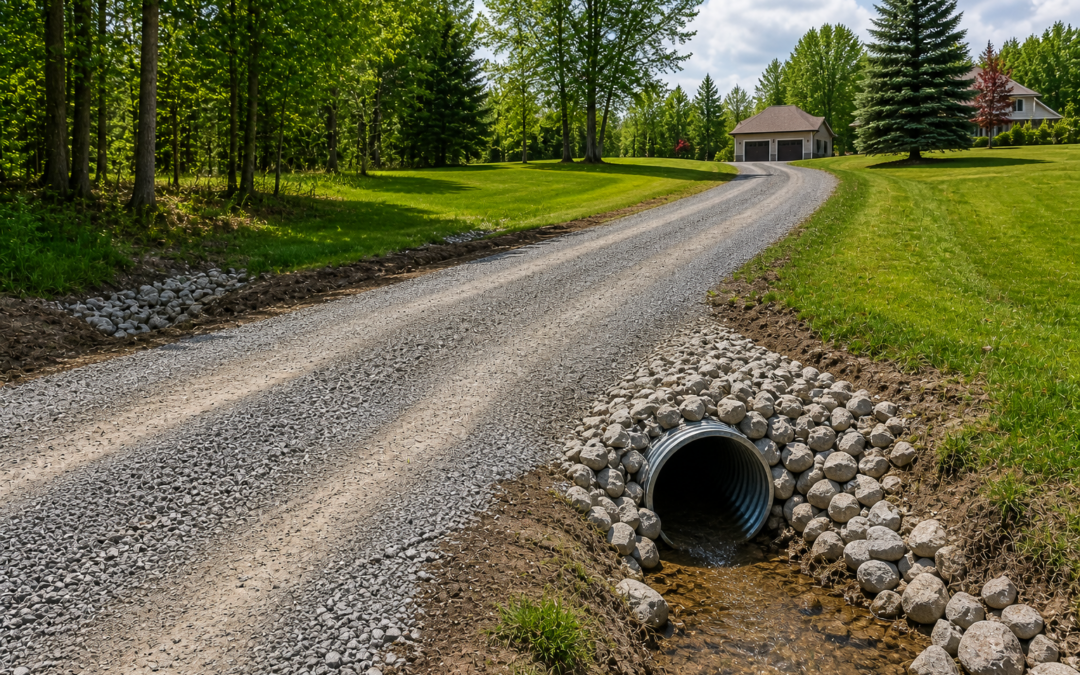
A driveway is expected to provide dependable access to a property through rain, snow, spring thaw, summer heat, and the repeated weight of vehicles. When potholes, ruts, low spots, cracking, washouts, or soft sections begin appearing, it can be tempting to focus only on repairing the visible surface. However, many recurring driveway problems actually begin below the surface.
A driveway is only as dependable as the ground and base supporting it.
Across Ottawa, Orléans, Rockland, Clarence-Rockland, Russell, and surrounding Eastern Ontario communities, driveways face demanding conditions throughout the year. Heavy rainfall can wash away material, spring snowmelt can saturate the ground, and freeze-thaw cycles can contribute to movement. Rural properties may also have long gravel driveways that cross natural drainage paths or areas with varying soil conditions.
At Gallant Services, we provide excavation, grading, drainage, land clearing, and site preparation services for residential and rural properties. When a driveway repeatedly develops problems, we look beyond the surface to understand whether drainage, grading, base preparation, soil conditions, or other site factors may be contributing.
A successful driveway project is not simply about placing new material. It begins by preparing the ground correctly.
A Driveway Is a Layered System
Whether a driveway is ultimately finished with gravel, asphalt, or another appropriate surface, the visible top layer is only one part of the system.
Below the finished surface is a prepared base that distributes vehicle loads and helps provide stability. Beneath that is the existing ground, which must be capable of supporting the driveway.
If one of these underlying components performs poorly, problems can eventually appear above it.
Common symptoms may include:
- Persistent potholes
- Deep tire ruts
- Sunken areas
- Uneven surfaces
- Gravel displacement
- Water pooling
- Edge erosion
- Repeated washouts
Adding more surface material may temporarily improve appearance, but it may not correct the underlying cause.
Poor Base Preparation Can Lead to Recurring Problems
The base is one of the most important parts of a driveway.
If unsuitable soil or organic material remains beneath the driveway, the surface may settle unevenly. If the base is too thin for site conditions or is not prepared appropriately, repeated vehicle traffic can contribute to deformation.
Professional driveway excavation may involve removing unsuitable material and preparing the area for an appropriate aggregate base.
The specific approach depends on the property, soil conditions, expected use, and finished driveway design.
At Gallant Services, we treat driveway preparation as a site-work project rather than simply a surface improvement.
Water Is One of the Biggest Threats to a Driveway
Drainage and driveway performance are closely connected.
When water cannot move away efficiently, it may collect on the driveway, saturate the base, or travel along the edges.
Over time, this can contribute to:
- Erosion
- Soft spots
- Material displacement
- Washboarding
- Potholes
- Washouts
The goal is to control water before it damages the driveway.
This can require adjusting the driveway grade, improving adjacent drainage, creating swales or ditches, or addressing culvert conditions where appropriate.
Why Potholes Keep Coming Back
A pothole may appear to be a simple surface defect, but repeatedly filling the same pothole is often a sign that another condition needs attention.
Water can collect in small depressions. Vehicle tires repeatedly travel through those areas, displacing material and gradually enlarging the depression.
If the drainage or base issue remains, fresh gravel may eventually be displaced again.
Instead of repeatedly treating the symptom, professional site work looks at why the pothole continues developing.
Correcting the grade and improving the underlying base can provide a more durable approach.
Low Spots Can Reveal Settlement
A section of driveway that gradually sinks may indicate settlement beneath the surface.
Settlement can develop for several reasons, including:
- Inadequately compacted material
- Unsuitable underlying soil
- Decomposing organic matter
- Excess moisture
- Previous excavation that was not restored appropriately
Low spots also tend to collect water, which can compound the problem.
Professional excavation allows affected areas to be opened, evaluated, and rebuilt when necessary rather than simply covered with additional material.
Gravel Driveways Need Proper Crowning and Grading
Many rural and semi-rural properties around Rockland, Clarence-Rockland, Russell, and surrounding Eastern Ontario communities use gravel driveways.
A well-prepared gravel driveway should encourage water to leave the driving surface rather than travel directly along it.
Depending on the site, the surface may be shaped with an appropriate crown or cross-slope so runoff moves toward drainage areas.
When the surface becomes too flat or develops wheel-track depressions, water can begin following the driveway.
Once flowing water finds a path, it can carry gravel with it.
Regular grading can help maintain the driveway’s shape, but underlying drainage problems may need to be corrected if washouts continually return.
Driveway Edges Need Protection Too
Water does not always damage the centre of a driveway.
Edge erosion can gradually reduce support along the sides, particularly where runoff is concentrated.
As material disappears, the driveway may become narrower or unstable near the edge.
Vehicles travelling too close to unsupported areas can accelerate deterioration.
Proper grading around the driveway helps direct water toward appropriate drainage paths instead of allowing it to cut away the base.
Culverts Can Determine Whether a Driveway Survives Heavy Runoff
Many rural driveways cross roadside ditches or natural drainage areas.
Culverts allow water to pass underneath these access routes.
When a culvert is obstructed, damaged, incorrectly positioned, or unable to manage site conditions, water can back up and eventually flow across the driveway.
The result may include:
- Gravel washouts
- Erosion
- Saturated driveway edges
- Access problems
- Damage around the culvert
Culvert installation or replacement should be coordinated with the surrounding grade and drainage pattern.
The objective is not merely to place a pipe beneath the driveway. Water needs a practical route into, through, and away from the culvert.
Long Rural Driveways Require Broader Planning
A short suburban driveway and a long rural driveway have very different site requirements.
Properties around Russell, Rockland, and Clarence-Rockland may have driveways extending significant distances from the road to the home, garage, workshop, or other structures.
Along that route, the driveway may cross:
- Low areas
- Slopes
- Natural drainage paths
- Different soil conditions
- Wooded sections
- Open fields
Each section may behave differently during heavy rain or spring thaw.
Professional excavation and grading can address the driveway as an entire system instead of repeatedly repairing isolated trouble spots.
Ottawa and Orléans Properties Have Different Challenges
Driveways in Ottawa and Orléans are often shorter, but limited space can make drainage especially important.
Neighbouring properties, walkways, landscaping, garages, and homes may all be located close to the driveway.
Water needs to be managed carefully so improvements do not simply move the problem somewhere else.
Professional grading can help coordinate the driveway with the surrounding property elevations and existing drainage conditions.
Spring Can Be Especially Hard on Driveways
Eastern Ontario’s spring thaw is an important test of driveway construction.
Snow can melt quickly while portions of the ground remain frozen or saturated. Water may have limited opportunities to drain, leaving the driveway base vulnerable.
Heavy vehicles travelling over saturated areas can contribute to rutting or deformation.
A properly prepared driveway with effective drainage has a better chance of managing these seasonal conditions.
Spring is also an excellent time to observe where water pools, crosses the driveway, or remains trapped along its edges.
These patterns can help identify areas requiring attention.
Freeze-Thaw Cycles Expose Weaknesses
Moisture that remains within or beneath a driveway can become problematic as temperatures repeatedly rise and fall around freezing.
Movement caused by seasonal conditions can make existing weaknesses more noticeable.
Poorly drained areas may experience greater deterioration than surrounding sections.
Effective drainage and appropriate base preparation cannot eliminate winter weather, but they can help create a driveway better suited to Eastern Ontario’s climate.
Heavy Vehicles Require a Stronger Foundation
Not every driveway carries the same loads.
A residential driveway may primarily support passenger vehicles, while a rural property might regularly accommodate:
- Pickup trucks
- Trailers
- Delivery vehicles
- Construction equipment
- Farm or property-maintenance machinery
If heavier traffic is expected, the driveway needs to be prepared accordingly.
The underlying ground, base depth, drainage, and width all become important considerations.
Gallant Services can prepare driveway areas based on how the property will actually be used rather than treating every driveway the same way.
New Driveway Construction Should Begin With Site Evaluation
Installing a new driveway provides an opportunity to address important site conditions before problems develop.
Planning should consider:
- Proposed driveway location
- Existing elevations
- Soil conditions
- Water movement
- Road access
- Culvert requirements where applicable
- Future buildings or property improvements
A driveway is often one of the first improvements completed on a new property because construction equipment needs access.
Preparing it properly from the beginning can support both the construction process and long-term property use.
Driveways and New Home Construction Should Be Coordinated
When preparing a property for a new home, the driveway should be considered as part of the complete site plan.
Its location can affect equipment access, drainage, utility routes, landscaping, and future structures.
For rural properties, driveway planning may also influence the location of garages, workshops, and parking areas.
Coordinating excavation work can reduce unnecessary disturbance and help the finished property function more effectively.
Drainage Ditches Need Maintenance and Correct Grading
On properties with roadside or private drainage ditches, the ditch itself needs an appropriate slope to keep water moving.
Sediment, vegetation, erosion, or changes in grade can reduce drainage effectiveness over time.
If water remains trapped beside the driveway, the surrounding ground may stay saturated.
Professional excavation can restore drainage routes where appropriate and help water move toward a suitable outlet.
Repairing a Driveway May Require More Than New Gravel
Fresh gravel can improve a driveway’s appearance, but additional material alone may not solve structural or drainage problems.
If the existing base is unstable, simply adding material increases the thickness of the surface without correcting what lies underneath.
Likewise, if water continually crosses the driveway, new gravel may eventually wash away.
A more complete repair may involve:
- Evaluating existing drainage.
- Removing unstable material.
- Correcting elevations.
- Rebuilding affected base areas.
- Improving drainage features.
- Placing and grading appropriate aggregate.
This approach addresses the driveway from the ground up.
Preparing Parking and Turnaround Areas
Driveway projects often extend beyond a narrow access lane.
Homeowners may also need:
- Parking areas
- Turnaround spaces
- Trailer parking
- Access to detached garages
- Equipment storage areas
These areas require proper excavation and grading because vehicles may repeatedly turn or remain parked in the same locations.
Water management is also important because larger prepared surfaces can change runoff patterns.
Gallant Services can incorporate these areas into the overall site preparation plan.
Future Development Can Affect Today’s Driveway Decisions
Property owners should consider how their access needs may change.
A driveway serving a home today may eventually need to provide access to:
- A detached garage
- A workshop
- An addition
- Additional parking
- Other property improvements
Planning for these possibilities can influence driveway alignment, width, drainage, and surrounding grading.
Thoughtful site preparation can make future development easier and reduce the need to rebuild completed areas.
When Is It Time to Consider Professional Driveway Excavation?
Some driveway maintenance is normal, particularly for gravel surfaces. However, recurring problems may indicate that deeper work is needed.
Consider a professional site evaluation when you notice:
- The same potholes repeatedly returning
- Deep ruts developing quickly
- Persistent standing water
- Significant gravel washouts
- Soft sections during wet weather
- Noticeable settlement
- Culvert-related erosion
- Water regularly flowing along the driveway
The sooner the underlying cause is identified, the easier it may be to prevent the damage from spreading.
Building a Driveway From the Ground Up
A dependable driveway is not created by the surface material alone.
It depends on the relationship between soil, excavation depth, base preparation, grading, drainage, and the way the property will be used.
At Gallant Services, we provide professional excavation and site preparation services designed to address these elements together.
From a new rural access road outside Russell to driveway drainage improvements in Rockland, grading work in Clarence-Rockland, or residential site preparation in Ottawa and Orléans, each project requires an approach suited to the property.
Professional Driveway Excavation Across Eastern Ontario
A failing driveway does not always need another temporary surface repair. Sometimes the most effective solution begins underneath it.
Gallant Services provides professional driveway excavation, grading, drainage, culvert work, land clearing, and site preparation throughout Ottawa, Orléans, Rockland, Clarence-Rockland, Russell, and surrounding Eastern Ontario communities.
We evaluate the property, water movement, existing grades, access needs, and underlying site conditions before determining the appropriate excavation and grading approach.
Whether you are building a new driveway, repairing recurring washouts, improving rural access, correcting drainage, or preparing a property for future development, we can help create a stronger foundation for the work ahead.
Contact Gallant Services for Driveway Excavation and Grading
If your driveway is developing potholes, ruts, washouts, soft areas, drainage problems, or recurring settlement, the problem may be deeper than the surface.
Call Gallant Services at (613) 834-0050 or email gallant.serv@gmail.com to discuss professional driveway excavation, grading, drainage, culvert, and site preparation services.
Gallant Services proudly serves Ottawa, Orléans, Rockland, Clarence-Rockland, Russell, and surrounding Eastern Ontario communities, helping property owners build stronger, better-drained, and more dependable access from the ground up.