
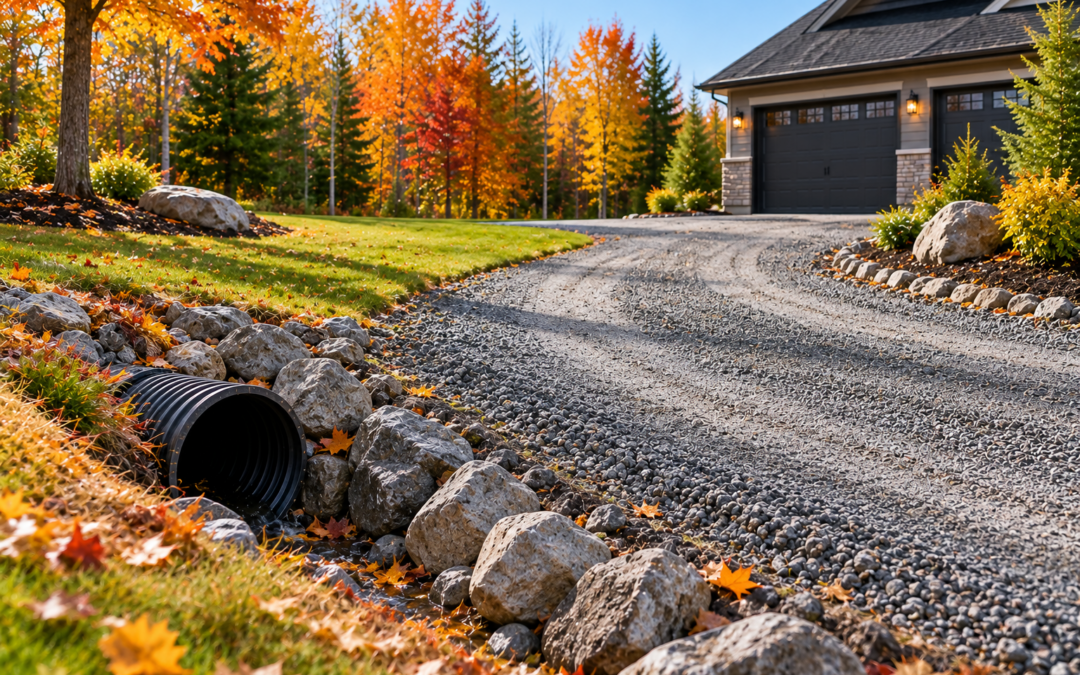
A driveway often shows the earliest signs that a property’s grading and drainage are not working as well as they should. Small potholes, soft edges, recurring ruts, washed-out gravel, or standing water may seem like routine maintenance issues, but they can also point to deeper site conditions beneath the surface.
Across Ottawa, Orléans, Rockland, Clarence-Rockland, Russell, and surrounding Eastern Ontario communities, fall is an ideal time to assess driveway performance. Autumn rain makes problem areas easier to see, while the approach of winter provides a useful reminder that water, freezing temperatures, and snowmelt can place even more stress on a weak driveway.
At Gallant Services, we provide professional excavation, grading, drainage, culvert work, land clearing, driveway preparation, and site preparation services. When a driveway repeatedly develops the same problems, we look beyond the surface to understand how the base, surrounding grade, and drainage are contributing.
Potholes Are Often a Symptom, Not the Cause
A pothole may appear to be a simple surface defect.
Filling it with gravel may improve the driveway temporarily, but if the same pothole keeps returning, the underlying cause may still be present.
Water can collect in a small depression, soften the surrounding material, and allow vehicle traffic to displace the surface repeatedly.
This cycle can continue throughout fall and become more noticeable after winter.
Professional driveway repair may involve correcting the base or drainage rather than simply adding more surface material.
Soft Areas Can Point to Weak Ground Conditions
A section of driveway that feels soft after rain may indicate that the supporting material below is retaining too much moisture.
This can happen when:
- The base is too thin
- Drainage is poor
- Unsuitable soil remains beneath the driveway
- Water is entering from surrounding areas
- The driveway is located in a natural low spot
In Eastern Ontario, these soft areas can become more problematic as temperatures fall.
Once saturated material freezes, movement can become more pronounced.
Proper excavation and base preparation can help create a more stable foundation.
Ruts Show Where Water and Traffic Are Working Together
Ruts often form where repeated vehicle traffic follows the same path.
If drainage is poor, water can remain in those depressions and deepen them over time.
This creates a self-reinforcing problem.
The deeper the rut becomes, the more water it holds. The more water it holds, the more easily material can shift under traffic.
Regrading the surface can help restore shape, but recurring rutting may indicate that the underlying base or drainage should also be evaluated.
Gravel Washout Is a Major Clue
When gravel repeatedly washes away after heavy rain, the problem is usually not the gravel itself.
It is the water.
Runoff may be travelling across or along the driveway with enough force to carry surface material downhill.
The solution may involve:
- Adjusting the driveway grade
- Improving nearby ditches
- Restoring a crown or cross-slope
- Improving culvert performance
- Redirecting runoff before it reaches the driveway
Replacing washed-out gravel without changing the water route can result in repeated repairs.
Driveway Edges Need Proper Support
Driveway edges are especially vulnerable to erosion.
Water can remove material from the sides, leaving the edge unsupported.
As vehicles travel near those areas, the surface may begin breaking down.
Property owners should look for:
- Narrowing edges
- Exposed base material
- Small erosion channels
- Drop-offs beside the driveway
These signs can become more serious during periods of heavy rain and spring thaw.
Proper grading around the driveway helps protect the edges and support the surface.
Culverts Play a Critical Role
On many rural and semi-rural properties, the driveway crosses a drainage ditch.
A culvert allows water to pass underneath the driveway rather than over it.
When the culvert is working properly, water continues through the drainage route.
When it is blocked, damaged, or poorly aligned, water may back up and begin affecting the driveway.
Potential signs include:
- Standing water near the inlet
- Erosion around the outlet
- Water crossing over the driveway
- Soft areas near the culvert
- Gravel washout
Gallant Services provides professional culvert excavation and drainage support for properties throughout Eastern Ontario.
Long Rural Driveways Need a Broader View
Properties in Rockland, Clarence-Rockland, Russell, and surrounding rural communities often have driveways that extend much farther than typical suburban access routes.
A long driveway may cross several drainage conditions along the way.
One section may be elevated and dry, while another travels through a low area.
Another section may cross a natural drainage route.
Professional evaluation looks at the entire driveway rather than only the most visible problem spot.
This broader approach can help identify where water is entering the driveway system and where it needs to leave.
Smaller Residential Driveways Have Different Challenges
In Ottawa and Orléans, driveways are often shorter but surrounded by more finished features.
Homes, garages, walkways, landscaping, and neighbouring properties can all sit nearby.
Drainage must therefore be precise.
A driveway that slopes incorrectly can direct water toward:
- A garage
- A walkway
- A foundation
- A low section of lawn
Even small elevation differences can matter.
Professional grading helps coordinate the driveway with the rest of the property.
Fall Rain Is a Useful Test
Autumn rainfall gives property owners valuable information.
After a heavy rain, look at how the driveway behaves.
Does water flow off quickly?
Does it collect in wheel tracks?
Does it move toward a garage or building?
Does it wash gravel toward the road?
Does it pool near a culvert?
These observations can help identify whether surface maintenance is enough or whether deeper work may be needed.
Winter Can Magnify Existing Weaknesses
Driveways that already have drainage problems often face additional stress during winter.
Water in the base can freeze, and repeated freeze-thaw conditions may contribute to movement.
Snowplowing can also disturb loose gravel and weak edges.
By spring, existing potholes and ruts may become larger.
Preparing the driveway before winter can help reduce the amount of moisture trapped in vulnerable areas.
Spring Thaw Is Often the Final Test
A driveway that appears acceptable during dry fall weather may perform very differently during spring thaw.
Snowmelt can saturate the base while the underlying ground remains partially frozen.
This can make weak areas soft and unstable.
Rural driveways carrying heavier vehicles may experience even more stress.
The better the drainage and base preparation, the more effectively the driveway can handle these seasonal conditions.
Proper Base Preparation Matters
The surface is only one part of a driveway.
The base beneath it provides much of the support.
Professional driveway preparation may involve:
- Removing unsuitable material
- Excavating to an appropriate depth
- Installing aggregate
- Compacting the base
- Establishing proper grades
This creates a stronger foundation for the finished surface.
When recurring problems are linked to weak base conditions, rebuilding affected areas can provide a more durable solution than surface repairs alone.
Water Should Leave the Driveway Quickly
A well-prepared driveway should not act as a drainage channel unless it is specifically designed to do so.
Water should generally move off the driving surface and toward appropriate drainage areas.
On gravel driveways, proper crowning or cross-slope can help encourage runoff away from wheel paths.
Adjacent ditches or swales can then continue carrying water through the property.
The goal is to keep water moving rather than allowing it to settle into the driveway structure.
Driveway Repairs Should Work With the Property Grade
A driveway cannot be evaluated in isolation.
The surrounding property influences how much water reaches it.
A higher lawn area may drain directly onto the driveway.
A slope above the property may contribute additional runoff.
A roof downspout may discharge near the driveway edge.
Professional grading looks at these surrounding conditions to understand the complete water pattern.
Preparing for Future Driveway Expansion
Some property owners plan to add:
- A detached garage
- Additional parking
- A workshop
- Trailer storage
- A wider turnaround area
These future improvements can change how the driveway needs to be used.
Planning ahead may influence:
- Driveway width
- Base thickness
- Drainage
- Culvert placement
- Overall alignment
Gallant Services can coordinate driveway preparation with broader site-development plans.
Driveway Work and Garage Construction Can Be Combined
If a new garage or workshop is planned, driveway improvements can often be coordinated with the same site work.
This may include:
- Extending access
- Preparing a parking area
- Improving drainage
- Excavating for the building
- Adjusting surrounding grades
Combining these tasks can help reduce repeated disturbance and create a more consistent finished site.
Why Professional Equipment Matters
Driveway excavation and grading require both power and precision.
Professional equipment can be used to:
- Remove weak material
- Shape the driveway
- Repair edges
- Improve drainage
- Prepare culverts
- Rebuild base areas
The appropriate machine depends on property size, access, and the extent of the work.
Gallant Services uses equipment suited to both rural and residential driveway projects.
Avoid Repeating the Same Temporary Repair
One of the clearest signs that deeper work may be needed is repeated repair in the same location.
If gravel is added every year to the same low area, if the same pothole returns, or if the same section keeps washing out, the problem may not be limited to the surface.
Professional evaluation can help identify whether drainage, base condition, or grading is responsible.
Addressing the cause can reduce the need for recurring maintenance.
Local Driveway Expertise Across Eastern Ontario
Gallant Services provides professional driveway excavation, grading, drainage, culvert work, land clearing, and site preparation throughout Ottawa, Orléans, Rockland, Clarence-Rockland, Russell, and surrounding Eastern Ontario communities.
We assist with:
- Gravel driveway preparation
- Driveway repair
- Base reconstruction
- Drainage improvements
- Culvert installation and replacement
- Rural access preparation
- Driveway extensions
- Parking and turnaround areas
Every property is different, which is why our approach considers soil, terrain, water movement, vehicle use, and future property plans.
Contact Gallant Services for Driveway Excavation and Grading
If your driveway is showing potholes, washouts, soft areas, ruts, drainage problems, or edge erosion before winter, these signs may be telling you that the ground beneath needs attention.
Call Gallant Services at (613) 834-0050 or email gallant.serv@gmail.com to discuss professional driveway excavation, grading, drainage, culvert work, and site preparation services.
Gallant Services proudly serves Ottawa, Orléans, Rockland, Clarence-Rockland, Russell, and surrounding Eastern Ontario communities, helping property owners build and maintain stronger, better-drained access through every season.