
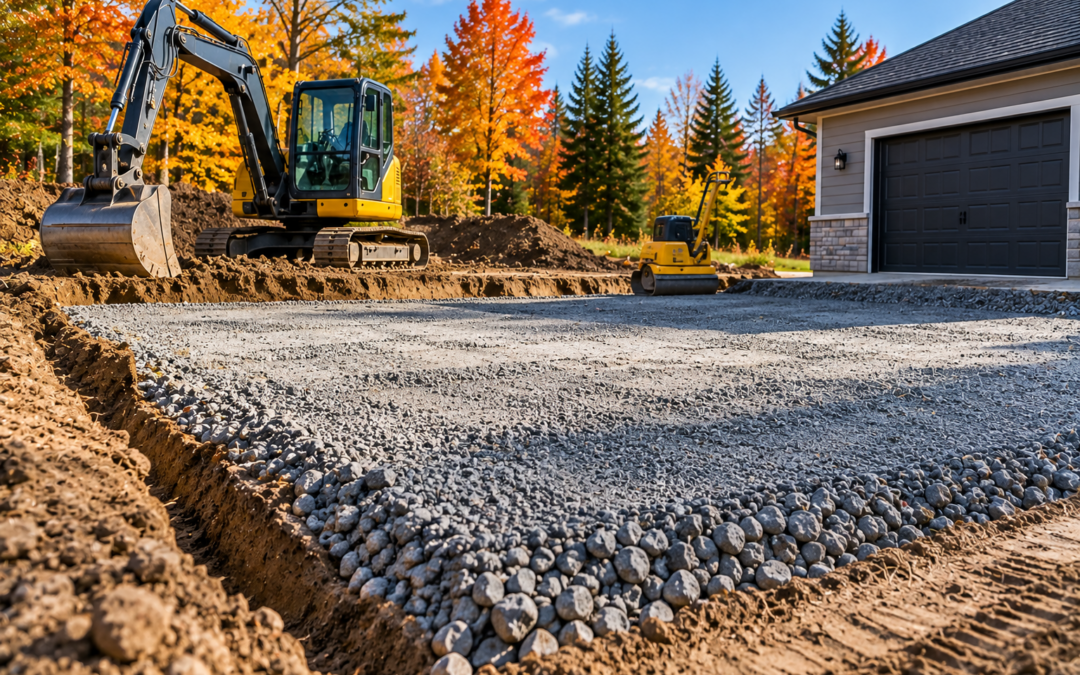
Every structure depends on what is underneath it.
A garage may look solid. A driveway may appear smooth. A patio may feel level and finished. But if the ground below was not properly prepared, those improvements can eventually develop problems that are difficult and expensive to correct.
Across Ottawa, Orléans, Rockland, Clarence-Rockland, Russell, and surrounding Eastern Ontario communities, soil conditions can vary significantly from one property to another. Some sites contain clay. Others include sandy material, loose fill, organic soil, or rocky ground. Seasonal moisture also changes how soil behaves throughout the year.
At Gallant Services, we provide professional excavation, grading, drainage, land clearing, driveway preparation, and complete site preparation services. One of the most important parts of that work is making sure the ground beneath a future structure or surface is prepared appropriately before construction begins.
Proper base preparation may not be visible once a project is finished, but it can influence long-term stability, drainage, and durability for years afterward.
A Finished Surface Can Hide an Unstable Base
When a driveway, patio, or building pad is complete, the ground underneath disappears from view.
That makes it easy to forget how important the base really is.
A finished surface may look excellent on the day the project is completed, but if the underlying material is weak, poorly compacted, or affected by drainage problems, movement can eventually develop.
Common signs may include:
- Uneven settlement
- Cracking
- Rutting
- Low spots
- Surface movement
- Water pooling
The visible problem is often only the final result of something happening beneath the surface.
Not All Soil Is Suitable for Building
Natural ground conditions vary widely.
Topsoil and organic material are generally useful for lawns and gardens, but they are not typically the type of material property owners want beneath permanent structural improvements.
Organic material can compress and change over time.
Soft soil may also struggle to support repeated loads.
Professional excavation helps remove unsuitable material where required and prepare the area for a more appropriate base.
The exact approach depends on the site and intended use.
Base Preparation Begins With Excavation
Before new aggregate or other base material can be placed, the site often needs to be excavated to the appropriate depth.
This creates room for the supporting layers beneath the finished surface.
Excavation also provides an opportunity to identify hidden site conditions such as:
- Soft ground
- Buried organic material
- Previous fill
- Drainage issues
- Unexpected soil changes
Finding these conditions early is valuable.
Once the site has been covered by concrete, asphalt, stone, or another finished surface, correcting the problem becomes much more disruptive.
Compaction Is Critical
Placing aggregate is not enough by itself.
The material needs to be properly compacted so it forms a stable support layer.
Loose material contains air spaces that can allow future settlement.
Professional compaction helps create a denser base and improves load distribution.
This is particularly important beneath areas that may support:
- Vehicles
- Garages
- Workshops
- Patios
- Parking areas
- Walkways
A stable base helps the finished surface perform more consistently.
Driveways Depend on Their Base
A driveway experiences repeated vehicle loads every day.
If the base is weak, the surface can begin showing damage.
Gravel driveways may develop deep ruts or potholes.
Paved driveways can experience cracking or settlement if the underlying material moves.
Professional driveway preparation may include:
- Removing weak soil
- Installing aggregate
- Compacting the base
- Establishing proper grades
- Improving drainage
At Gallant Services, we treat driveway construction from the ground up rather than focusing only on the surface.
Garage Pads Need Proper Support
Detached garages and workshops can place substantial weight on the ground.
Before construction begins, the building area needs to be prepared according to the requirements of the project.
Site preparation may include clearing, excavation, removal of unsuitable material, base installation, grading, and drainage planning.
Ignoring weak ground conditions can create unnecessary risk later.
A strong building begins with strong site preparation.
Patios and Outdoor Living Areas Need Stability Too
Patios may not carry the same loads as a garage, but they still need proper support.
Poor base preparation can contribute to:
- Uneven pavers
- Low areas
- Surface movement
- Standing water
Outdoor living areas are often located close to the home, so drainage also becomes important.
Professional excavation helps prepare both the base and surrounding grade before the final surface is installed.
Drainage and Base Stability Are Connected
Water is one of the biggest threats to a prepared base.
Even a well-compacted area can perform poorly if it remains saturated.
This is why base preparation and drainage should be planned together.
Proper grading helps direct surface runoff away.
Where necessary, drainage improvements may also be incorporated into the site.
The objective is to protect the supporting material beneath the finished project from unnecessary moisture.
Clay Soil Can Create Additional Challenges
Clay-rich soil is common in parts of Eastern Ontario.
Clay can retain moisture and behave differently through seasonal changes.
When wet, it may become softer.
During colder weather, moisture in the ground can contribute to freeze-thaw movement.
This does not mean construction cannot take place on clay-heavy properties.
It simply means that site preparation should account for existing soil conditions.
Professional excavation allows unsuitable material to be addressed before final construction begins.
Rural Properties Often Require Larger Base Areas
Properties throughout Rockland, Clarence-Rockland, Russell, and surrounding rural communities often include larger development areas.
Projects may involve:
- Long driveways
- Large garages
- Workshops
- Equipment parking
- Storage areas
These surfaces may need to support heavier vehicles and more frequent use.
Professional base preparation becomes especially important in these situations.
The larger the prepared area, the more important consistency and drainage become.
Urban Properties Need Precision
Ottawa and Orléans projects can involve smaller working areas but still require careful preparation.
A garage addition, patio, walkway, or driveway extension may need to fit between existing structures and landscaping.
There may be limited space available for equipment or material storage.
Professional excavation helps focus the work within the necessary area while maintaining proper grades and surrounding drainage.
Soft Ground Should Not Be Covered Up
One of the biggest mistakes during construction is ignoring soft ground.
Adding more gravel on top may temporarily create a solid-looking surface, but the weak material underneath remains.
Over time, loads can cause the area to settle or move.
Proper site preparation may require removing the problem material and rebuilding the base from a more stable level.
This takes more effort initially, but it can provide a much stronger long-term result.
Base Thickness Depends on the Project
Different projects place different demands on the ground.
A light garden walkway does not require the same preparation as a driveway carrying vehicles.
Likewise, an equipment parking area may need more robust preparation than a standard residential access route.
This is why base preparation should be planned according to actual use.
At Gallant Services, we evaluate what the finished area needs to support before determining the excavation approach.
Water Pooling Can Reveal Base Problems
Standing water on a finished surface may indicate poor grading, but it can also signal settlement beneath the surface.
If a section sinks, water naturally collects there.
Repeated moisture can then make the problem worse.
Correcting the visible low spot without addressing the reason it settled may only provide temporary improvement.
Professional excavation allows the affected area to be rebuilt properly when deeper base issues are involved.
Fall Is a Good Time to Spot Weak Areas
Autumn rainfall can reveal sections of a property that remain soft or saturated.
A driveway may develop ruts.
A future building area may hold water.
A low section of yard may stay muddy for days.
These conditions provide useful information before winter.
Property owners planning construction in the future can use fall observations to identify where additional site preparation may be needed.
Winter Can Expose Poor Preparation
Freeze-thaw cycles can make weak areas more obvious.
Moisture trapped beneath a surface can contribute to movement as temperatures change.
By spring, a driveway, patio, or unfinished construction area may show signs of settlement.
Proper drainage and base preparation help reduce unnecessary moisture and create better ground conditions before winter arrives.
Base Preparation Should Support Future Plans
A property may change over time.
A driveway may later extend toward a new garage.
A gravel parking area may eventually support a workshop.
A backyard may later become an outdoor living space.
If future development is already part of the plan, early site preparation can account for those needs.
Thinking ahead may reduce the amount of excavation required later.
Professional Equipment Helps Achieve Consistent Results
Base preparation requires accurate excavation and material handling.
Professional equipment can be used to:
- Remove unsuitable soil
- Shape the area
- Place aggregate
- Grade the surface
- Prepare drainage routes
The right machinery helps create consistent conditions across the project.
Gallant Services uses equipment suited to both large rural sites and smaller residential properties.
The Best Base Is the One You Never Have to Think About
Once a project is finished, the base should disappear from attention.
Homeowners should be able to use their driveway, garage, patio, or parking area without constantly thinking about the ground underneath.
That is the goal of good site preparation.
The work may not be visible, but it quietly supports everything above it.
Professional Base Preparation Across Eastern Ontario
Gallant Services provides professional excavation, base preparation, grading, drainage, driveway preparation, land clearing, culvert work, and site preparation throughout Ottawa, Orléans, Rockland, Clarence-Rockland, Russell, and surrounding Eastern Ontario communities.
We prepare sites for:
- Driveways
- Detached garages
- Workshops
- Parking areas
- Patios
- Outdoor living spaces
- Other property improvements
Every property has different soil, drainage, and load requirements, which is why our approach is based on actual site conditions.
Contact Gallant Services for Professional Site Preparation
A strong finished project starts with stable ground beneath it.
If you are planning a driveway, garage, workshop, patio, parking area, or other property improvement, professional excavation and base preparation can help create a more dependable foundation.
Call Gallant Services at (613) 834-0050 or email gallant.serv@gmail.com to discuss professional excavation, grading, drainage, base preparation, land clearing, driveway preparation, and site preparation services.
Gallant Services proudly serves Ottawa, Orléans, Rockland, Clarence-Rockland, Russell, and surrounding Eastern Ontario communities, helping property owners build from the ground up with careful, professional site preparation.